Fix & Maintain
Robot Vacuum Ramps and Thresholds
A robot that stops at the same doorway every run is usually meeting a lip taller than it can climb. Here is the height each maker says its robots cross, the signs a ramp would help, and the one strip Roborock sells itself.
As an Amazon Associate we earn from qualifying purchases, at no cost to you. How we make money.
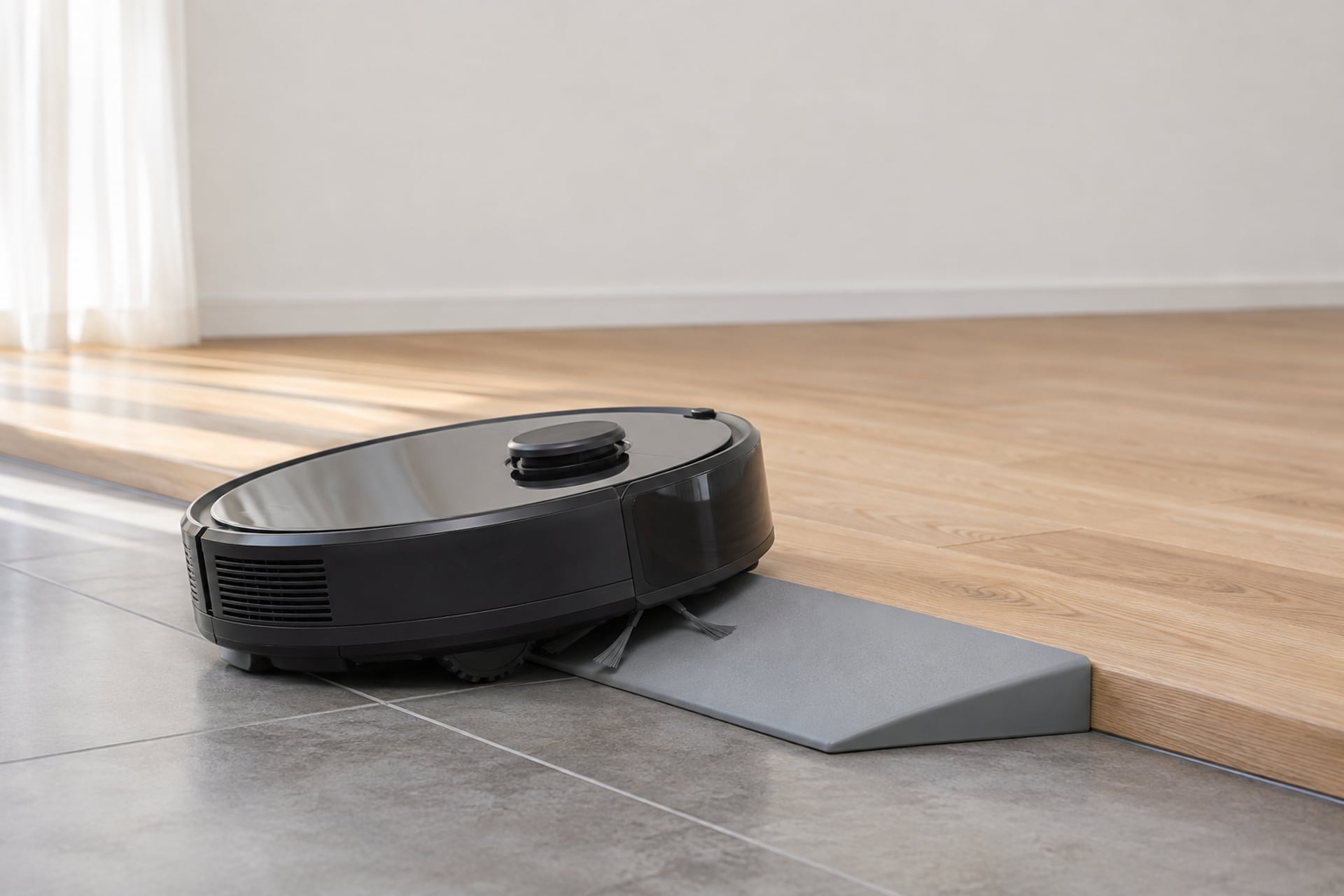
Most robot vacuums are happy on a flat floor and lost at a raised doorway. The robot drives up to the lip, spins its wheels, backs off and tries again, and then either gives up or wedges itself on the edge. If that sounds like your home, the fix is usually one of two things: a robot with a higher climbing rating, or something that makes the lip shorter, which is what a ramp or a threshold strip does.
This guide starts with the numbers. Each maker publishes a threshold height for its robots, but the figures are not measured the same way, and the biggest ones only apply to a particular double step. Then we cover the signs that a ramp would help, the threshold strip Roborock sells, the other fixes that cost nothing, and the robots that cope with high lips on their own.
We work from the makers' own pages and support articles, and from one retailer listing, all read on November 20, 2026, and the sources are listed at the end. Where a maker does not state a height, the table says "not stated" instead of guessing.
How High Can a Robot Vacuum Climb?
The honest answer is that it depends on the model, and on whether the lip is a single step or two steps close together. A plain robot is built for the small rise between a hard floor and a rug or a door track. A newer robot with a lifting chassis or lifting legs can clear much more, but only under conditions the maker spells out.
Standard Robots
iRobot says every Roomba can cross a threshold up to 5/8 inch (1.6 cm) high during a cleaning cycle. eufy's guide describes most standard robot vacuums as built to climb thresholds of around 15 to 20 mm. A lip of two centimeters or more is therefore beyond a typical entry-level robot, which is why the same doorway can stop one robot and not another.
Robots With Lifting Chassis
The higher figures come from robots that raise their body or wheels. Roborock rates the Saros 20 at up to 8.8 cm, but only as a double-layer threshold: the first step no higher than 4.5 cm, the second no higher than 4.3 cm, and a gap between them of more than 12 cm and no more than 14 cm. Roborock adds that actual performance may vary with the home and how you use it. Digital Trends describes the Qrevo Curv as able to climb thresholds up to 4 cm tall, and says a single-layer threshold over 3 cm, or a double-layer one over 4 cm, is not supported.
Why the Headline Number Misleads
Read the wording around any maker's number before you measure your door. A double-layer rating describes two steps with a set gap, not one tall wall. If your lip is a single block, use the single-layer figure, which is lower. And if the lip is on carpet or has a dark or recessed edge, the robot may sense it badly, so leave yourself margin.
Stated Threshold Heights by Brand
The table lists only what each maker's own pages say. Heights are as stated, and the type of step is given where the maker gives it. Anything the maker does not publish is marked "not stated".
| Brand and model | Height stated | What it applies to |
|---|---|---|
| iRobot, every Roomba | 5/8 in (1.6 cm) | Threshold crossed during a cleaning cycle, for all Roomba models |
| Roborock Saros 20 | Up to 8.8 cm (4.5 cm + 4.3 cm) | Double-layer threshold, gap over 12 cm and up to 14 cm |
| Roborock Qrevo Curv | Up to 4 cm | Per Digital Trends; over 3 cm single-layer or over 4 cm double-layer is not supported |
| eufy Omni S2 | 3.5 cm single, 4.2 cm double | Single and double thresholds, per eufy's guide |
| eufy Omni E25 | Not stated | eufy describes it as suited to standard thresholds |
| Dreame L50 Ultra | 2.36 in (6 cm) | Listed by Dreame as obstacle clearing, ProLeap |
| Dreame X60 Ultra | 3.47 in | Listed by Dreame as crossing height |
| Shark robots | Not stated | We could not open a Shark page that gives a height |
One caution on reading the table. A maker's listing height is the best case, and the three kinds of number (single threshold, double threshold, general obstacle clearing) are not interchangeable. If you are comparing two robots for a particular doorway, compare the same kind of number for both.
Signs You Need a Ramp
Not every stuck robot needs a ramp. A ramp earns its place when the lip itself is the problem, not the robot's mapping or a loose cable. Look for these signs before you buy anything.
The Robot Fails at the Same Spot Every Run
If the robot gets stuck, spins or gives up at one specific doorway or step and cleans the rest of the home fine, the height at that spot is the likely cause. Measure it with a ruler and compare it with the figure in the table above for your model, using the single-layer number unless the lip really is two steps.
The Rise Is a Little Over Your Robot's Limit
eufy's guide says a ramp is useful when a threshold is taller than your robot's climbing limit, has a sharp edge, or separates two floor levels, and notes that it helps with rises of a couple of centimeters and with single internal steps that are only slightly too high. That matches the sweet spot: a lip a little over the rating. A drop of ten centimeters between two rooms is a different problem and needs a different robot or a barrier.
The Edge Is Sharp or the Slope Is Dark
A hard, square edge gives the wheels nothing to grip. Roborock also warns that some dark-colored, recessed or multi-level thresholds can affect passage, which is a sign that the sensors and the geometry both matter, not just the height.
The Official Roborock Threshold Strip
Roborock sells its own strip through the Roborock seller on Amazon US. It is the one ramp product we link, because it comes from the maker of the robots it is meant for. We do not link unbranded rubber ramps: we cannot read who makes them or how they were built.
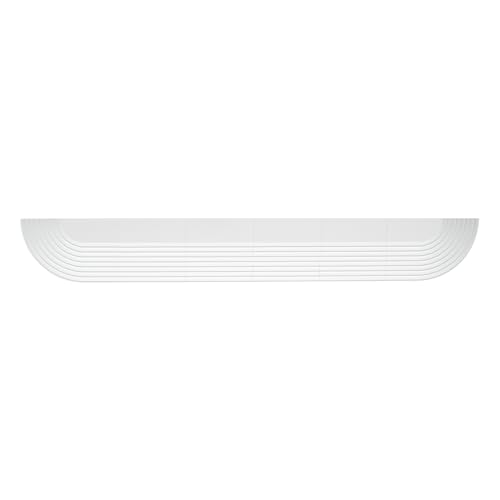
Top pick · Best for a lip just over the limit
Roborock Threshold Strip
A single gray strip, 27.17 inches long and 3.74 inches wide, that the listing says lets the robot cross a 2.8 cm threshold. It is for a low track, not for a tall step.
- Budget
- Buy it if
- You own a Roborock and the robot stops at a door track of about 2.8 cm or less, and the track is wider than 10 cm.
- Skip it if
- Your lip is tall, narrower than 10 cm, dark, recessed or multi-level, or your robot is not a Roborock. The listing says those thresholds can still stop the robot.
The listing states that the strip is compatible with all Roborock robot vacuums and that it supports up to 150 kg. Its size is 27.17 by 3.74 by 0.71 inches, the color is gray and one strip comes in the pack. It says the strip lets the robot traverse a 2.8 cm threshold, and asks you to make sure the threshold width is greater than 10 cm, adding that some dark-colored thresholds, recessed thresholds and multi-level thresholds may affect passage. It also carries a note that Roborock parts are best bought from the Roborock store. That note is from a company that sells the part, so weigh it as such.
Read the 2.8 cm figure as a limit, not a promise for every home. Compare it with the height you measured, and leave a margin if the edge is sharp or the floor is carpet. Our Roborock replacement parts guide covers the other consumables for the same robots.
What stands out
- Sold by Roborock itself on Amazon US
- Listing states compatibility with all Roborock robot vacuums
- Listing states support up to 150 kg
- A strip 27.17 inches long covers a wide doorway
Trade-offs
- Listing states a 2.8 cm threshold, so it does not suit a tall step
- The threshold must be wider than 10 cm, per the listing
- Dark, recessed or multi-level thresholds may still affect passage, per the listing
- Only one strip per pack
Other Fixes Before You Buy a Ramp
Several fixes cost nothing and are worth trying first, especially if the lip is only a little over your robot's rating or if the robot is getting stuck on something other than height.
Use a No-Go Zone or a Threshold Marker
Most robot apps let you draw a no-go zone across a doorway the robot cannot cross, which is the cheapest option when a doorway is not worth the trouble. On Roborock, Digital Trends describes a different step: in the app, open Floor Cleaning Setting, choose Edit Surface, pick Threshold and place a threshold marker on the map over the problem spot, so the robot knows to approach it differently.
Lift or Remove a Loose Rug Edge
A rug with a curled or thick edge near a door raises the effective height of the lip. Flatten it, tape it down with a rug gripper or take it away for the run. This often solves a robot that seems to fail only in one doorway.
Clear the Path and the Brush
A tangled main brush or a wheel clogged with hair can make a robot lose traction on a slope it could normally climb. If it also struggles at flat spots, work through our robot vacuum troubleshooting guide before blaming the threshold. Parts that wear out are collected on our robot vacuum replacement parts page.
We do not recommend building anything that sits permanently across a walkway without checking it is stable and will not trip people or pets. A strip that slides is worse than no strip.
Robots That Climb Higher
If the lip is well over what a ramp can fix, or you have several of them, the better answer may be a different robot. Our best robot vacuums for stairs and thresholds guide covers the models built for raised floors, and our Dreame X50 Ultra guide looks at one of the climbing flagships in detail. To line models up side by side, use our comparison tool.
Product prices and availability are accurate as of the date/time indicated and are subject to change. Any price and availability information displayed on Amazon.com at the time of purchase will apply to the purchase of this product. Prices on this page are read again from Amazon once a reading is an hour old, and a price is hidden when the latest reading is more than 24 hours old. CERTAIN CONTENT THAT APPEARS ON THIS SITE COMES FROM AMAZON. THIS CONTENT IS PROVIDED 'AS IS' AND IS SUBJECT TO CHANGE OR REMOVAL AT ANY TIME.
Sources
- iRobot Support, threshold height Roomba can cross, homesupport.irobot.com, read on November 20, 2026 Source for the 5/8 inch (1.6 cm) threshold limit for all Roomba models.
- Roborock, Saros 20 product page, global.roborock.com, read on November 20, 2026 Source for the 8.8 cm double-layer rating (4.5 cm + 4.3 cm) and the 12 to 14 cm gap condition.
- Digital Trends, How to clear tall thresholds with the Roborock Qrevo Curv, digitaltrends.com, read on November 20, 2026 Source for the Qrevo Curv 4 cm figure, the 3 cm single-layer limit and the app threshold marker steps.
- eufy, Robot vacuum ramp guide (hosted on anker.com), anker.com, read on November 20, 2026 Source for the Omni S2 3.5 cm and 4.2 cm figures, the 15 to 20 mm standard range, when a ramp helps and the DIY steps. The page gave no mop-robot ramp advice.
- Dreame, site navigation product taglines, dreametech.com, read on November 20, 2026 Source for the L50 Ultra 2.36 in obstacle clearing and the X60 Ultra 3.47 in crossing height. Article body figures were not readable.
- Amazon listing, roborock Threshold Strip for All Series Robot Vacuums (B0DTDJPZWC), read on November 20, 2026 Source for the 2.8 cm threshold, 150 kg support, 10 cm width condition, size, color and the seller note.