Decision guide
Are Robot Vacuums Worth It?
A room-by-room answer: who gets the most from a robot vacuum, who should keep the stick vacuum, what you still do by hand, and what each price tier buys.
As an Amazon Associate we earn from qualifying purchases, at no cost to you. How we make money.

For most homes, yes: a robot vacuum is worth it if you want floors kept clean every day without doing it yourself. It is not worth it if your home is mostly stairs, if the floor is usually covered in things, or if you expect it to replace a proper vacuum cleaner. The honest answer depends on four things: what is on your floors, how many pets you have, how much time you want back, and how much clutter the robot must steer around.
This guide answers by situation rather than by spec sheet. It tells you who gets the most from a robot, when it is a poor fit, what you will still do by hand, what each price tier buys, and how long one lasts. At the end are three safe starting points, one per tier. We do not print prices, because they change daily.
Who Gets the Most From a Robot Vacuum
A robot vacuum works best when the same kind of mess comes back every day. That is a different job from a deep clean, and it is what a robot is good at. If one of the situations below sounds like your home, the answer is almost certainly yes.
Homes With Pets
Pet hair is the best reason to own a robot. It lands on the floor every day, so a robot that runs every day keeps it from building into tumbleweeds. Look for a brush built to resist wrapping. Roborock describes the Q7 M5+ brushes as resisting pet hair wrap "even from long-haired breeds," and says its app lets you set no-go zones around pet areas. A robot also frees you from the loop of vacuuming a shedding dog's hair twice a week.
Hard Floors and Daily Crumbs
Hardwood, tile and laminate show every crumb. A robot that runs while you are out catches the kitchen and hallway before the crumbs are walked into the next room. Mapping robots let you choose which rooms to run, so you can send the robot to the kitchen after dinner and nowhere else.
Low Furniture and Hard-to-Reach Places
The dust that bothers people most collects under beds and sofas, where a stick vacuum is awkward to push. Slim robots get there for you. Roborock states the Saros 10R is 3.14 inches tall and uses a 3D sensing system instead of a raised laser turret, which is what lets it slip under low furniture.
People Who Do Not Want Another Chore
The real benefit is not the cleaning, it is the time. A robot on a schedule turns "vacuum the floors" into something that has already happened. For busy households, that is often the whole reason.
When a Robot Vacuum Is Not Worth It
A robot vacuum is a poor buy in a few specific cases. Knowing them before you buy saves you the return.
Stairs-Only or Multi-Level Homes
A robot cannot climb stairs. If your living space is spread over several floors, you carry it up and down, and the dock stays on one floor. Some mapping robots save more than one floor map, which helps, but you still move the machine. A small flat on one level is a better fit than a house of split levels. Makers do list threshold figures: Roborock rates the Saros 10R to climb obstacles up to 4 cm, which covers many door thresholds but not stairs.
Floors That Are Always Cluttered
A robot cleans what it can reach. Cables, toys, shoes and clothes on the floor jam brushes or send the robot to a stop. The better robots detect and avoid objects. Roborock says the Saros 10R recognizes 108 obstacle types and can clean along cables, but no robot makes a cluttered floor clean on its own. If you will not pick things up, expect interrupted runs.
Deep Shag and Long-Pile Rugs
Long, thick carpet is hard on any robot. The listings we read describe carpet handling only in terms of suction boosts and mop lifting. Roborock states the Saros 10R lifts its mops to avoid wetting long-pile carpets. Whether any robot lifts embedded dirt from deep shag is not something the makers state, so a stick or upright vacuum is still the safer tool there.
What You Still Do by Hand
A robot cleans the floor. It does not clean the house. Be realistic about what stays on your list.
Stairs, Upholstery and Cars
Stairs, sofas, mattresses, curtains and car seats are all outside a robot's reach. Keep a small handheld or a stick vacuum for them.
Emptying the Bin
A basic robot holds a small bin that you empty after most runs. The Roomba 105 Vac charges on its dock and nothing more, so you empty it yourself. A self-emptying dock moves the dust into a sealed bag: Roborock rates the Q7 M5+ dock at up to 7 to 9 weeks and the Saros 10R dock at 60 days of dust collection. Ask yourself how much you mind this task, because it is the biggest difference between tiers.
Brushes, Filters and Sensors
Hair wraps around brushes even with anti-tangle designs. Cut it off when you see it. Wipe the sensors, rinse or replace the filter, and wash mop pads if your robot does not do it for you.
What Each Price Tier Buys
Prices on robot vacuums move every week, and the same model can sit in two tiers in one month, so we use tiers instead of numbers. What does not move is what each tier gives you.
Budget
Laser mapping and neat rows are available here. You give up a self-emptying dock and a real mop. Best for small homes and daily touch-ups.
Starting point below: Roomba 105 Vac. More in our cheap robot vacuum guide.
Mid-range
The sweet spot for most buyers. A self-emptying dock is common, suction ratings climb, and better docks also wash and dry the mop.
Starting point below: Roborock Q7 M5+. More in our self-emptying robot vacuum guide.
Premium
You pay for the last mile: slimmer bodies, camera or 3D avoidance, hot-water mop washing, detergent dosing and docks that clean themselves.
Starting point below: Roborock Saros 10R. More in our vacuum and mop guide.
A rule that holds across the range: spend on the dock before you spend on suction. Every robot here picks up everyday dust. What you feel each week is how often you empty, rinse or untangle something.
How Long a Robot Vacuum Lasts
No maker in the listings we read gives a lifespan in years, so we will not either. What we can say is how a robot ages. It wears out in its parts before it wears out as a whole.
Parts That Wear Out First
Brushes, filters, side brushes, mop pads and dust bags are consumables. The battery is the one large part that ages, and replacing it is what decides whether an old robot is worth keeping. Before you buy, search for the replacement brushes, filters and bags for that exact model. If nothing comes up, the robot will be hard to keep running.
Warranty Is the Only Number Makers Give
The iRobot Roomba 105 Vac listing states a 1 year manufacturer warranty. The Q7 M5+ and Saros 10R listings do not state a warranty term, so check the seller's page before you buy.
Software Counts Too
A robot depends on its app for maps and schedules, and the app depends on the maker. A big, established brand is the safer bet for updates over the life of the robot.
Three Safe Starting Points
If you have decided a robot is worth it, these are three sensible places to start, one per tier. Each is a current model; we picked them for what they do well, and each review says who should skip it.

Best budget start
iRobot Roomba 105 Vac
The lowest-risk way to find out if a robot suits you. It maps the house, cleans in rows and takes room commands from the app.
- Budget
- Buy it if
- You have a small or medium home and want to try a robot without a big commitment.
- Skip it if
- You want mopping, or you will not empty a bin by hand.
iRobot lists ClearView LiDAR mapping, a multi-surface brush and an edge-sweeping brush, plus room scheduling and keep-out zones in the Roomba Home app. The robot recharges and resumes where it stopped. The dock only charges, and the listing gives no mop, runtime or bin size.
What stands out
- LiDAR mapping at the lowest tier
- Room selection and keep-out zones
- Recharges and resumes on its own
Trade-offs
- No mop
- Empty the bin by hand
- Suction not stated in Pa

Best mid-range start
Roborock Q7 M5+
The one that removes the chore people hate most. It empties itself into a sealed bag and maps with LiDAR.
- Mid-range
- Buy it if
- You have pets or a larger home, and you want to touch the robot as little as possible.
- Skip it if
- You want a dock that washes the mop; the listing describes emptying only.
Roborock lists 10,000 Pa suction, PreciSense LiDAR navigation and a RockDock Plus with a 2.7 L sealed bag rated for up to 7 to 9 weeks. The brushes are meant to resist pet hair wrap, and the app sets no-go zones. The mop is a pad with three water-flow settings. The robot works on 2.4 GHz Wi-Fi only.
What stands out
- Self-emptying dock, 7 to 9 weeks per the maker
- LiDAR mapping with no-go zones
- Anti-tangle brushes for pet hair
Trade-offs
- Mop washing by the dock not stated
- 2.4 GHz Wi-Fi only

Best premium start
Roborock Saros 10R
For a household that wants the floors handled completely. It is slim, mops with spinning pads that lift on carpet, and the dock empties, washes and dries.
- Premium
- Buy it if
- You have mixed floors, low furniture and a busy household, and you would rather pay once for the least attention.
- Skip it if
- Your home is small enough that a mid-range dock does the same job.
Roborock lists a 3.14-inch body, StarSight 3D sensing, 22,000 Pa suction and a dock with 60-day dust collection, auto refilling, detergent dosing, 176°F mop washing and 131°F hot-air drying. It can climb obstacles up to 4 cm. It has a built-in camera.
What stands out
- 3.14 inches tall, per the maker
- Dock empties, refills, doses detergent, washes and dries
- Mops lift on carpet
Trade-offs
- More robot than a small flat needs
- Built-in camera may not suit everyone
- Wi-Fi band not stated
Where to Go Next
Once you know a robot is worth it, the next step is picking one for your home. These guides go deeper.
-
 Best robot vacuumsPicks by home, floor and budget.
-
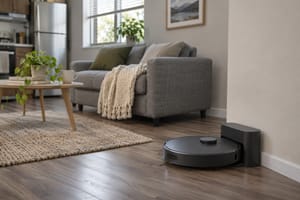 Best cheap robot vacuumsWhat the budget tier gives up.
-
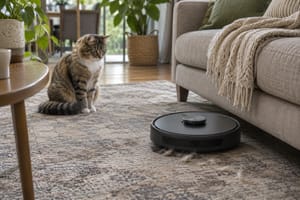 Best for pet hairBrushes and docks for shedding pets.
-
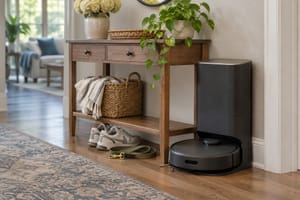 Best self-emptyingDocks that empty for weeks.
-
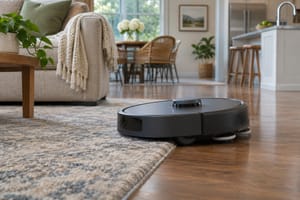 Best vacuum and mopWhich mop type fits your floors.
Robot Vacuum FAQ
Sources
- Manufacturer product listings for the Roomba 105 Vac, Roborock Q7 M5+ and Roborock Saros 10R, Amazon US, read on November 6, 2026 Every specification on this page is the maker's stated figure from its listing.
The RobotVacuumer letter
New robot vacuum picks and plain advice on choosing and living with one, about once a month.